|
|
Three weeks ago, I returned from spending two wonderful
weeks in East Africa. As you probably know, a week of the trip was spent
on climbing Mt. Kilimanjaro with my daughter Aliya, in a group that totaled
11 climbers, while the second week was spent on a game safari.
I was delighted
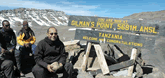
to be able to reach Gillman's point, at the top of the mountain, at almost
19,000 feet, with two other colleagues. Seven other members of the team
made it further, to Uhuru Peak at 19,340 feet. And Aliya made it all the
way to 17,000 feet before being completely overcome with nausea, an important
indicator of Altitude Mountain Sickness. She turned back and made it back
to camp safely with her guide. A remarkable team record, all in all, due
to the longer route we took getting there, and thus, added acclimatization.
Many people have asked
me what it was like. All I can say is that the hike to base camp (4 days,
ascending from 5,000 feet to 16,000 feet), the hike up the mountain, and
two days of hiking back was extremely grueling and physically challenging
for me! But it was an incredible journey that I shall cherish forever.
I had many compelling
reasons for undertaking this challenge. These reasons motivated me to
get to the top of the mountain despite many obstacles along the way. I
am pleased to share them below.
- To prove to myself
that I can take on a huge physical challenge and accomplish it, given
my previous history of major back problems.
- A 21st birthday
gift for (my daughter) Aliya that she will cherish for the rest of her
life.
- To inspire others
to set and accomplish huge goals - if I can do this, others can achieve
tons in their lives.
- To experience and
celebrate nature through a photo-essay, what I hope will be the start
of many such photo-essays.
- Because I have
told the world I am doing it!
- To have time for
deep reflection, out-of-the box thinking, and different perspectives
on life.
- To experience first
hand the challenge of the mountain so that I can assess its suitability
as a leadership challenge for high school students at independent schools
in Canada.
- To help students
raise funds for scholarship endowments at their schools and for local
child-centered, educational initiatives.
- To raise awareness
of the HIV/AIDS pandemic among independent school students in North
America, and involve them in solutions.
- To fulfill a 33
year dream from when I first flew over the mountain as a young lad.
There are many "lessons"
I learnt from the climb, which I am pleased to share below, as I believe
they are very applicable in our daily lives.
-
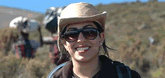
Set a
huge goal! Given that less than three years ago, I could
not walk to the end of my driveway, climbing Mt. Kilimanjaro and hiking
for six days was something I could only dream about then. The photo
above is a dream come true, and is clear proof that we all have the
capability of setting and achieving huge goals.
-
Persevere.
In any journey, there will be many obstacles. Often, the easy thing
to do is to turn back, as I was tempted to do over a 100 hundred times
on the entire journey. In fact, when I was utterly exhausted, I focused
on taking a few small steps, and then pausing. Bit by bit, the top
appeared closer - and then we were there (Ok, it was ten hours later,
but you get the point!).
-
Change
plans when necessary to avoid unnecessary risks/danger. The
day before the climb, it became clear to me that as much as I aspired
to reach the summit the next morning at Uhuru Peak, given my walking
speed to that point (about 1.5 times slower than the rest of the group),
I would have to re-establish my goal as being to get to Gillman's
Point. This would minimize the high risk of Altitude Mountain Sickness
after some ten hours on the mountain, and would ensure that I was
not caught up in heavy cloud either getting to or from Uhuru Peak
in the late morning. It was only when I encountered cloud on my way
back near base camp, and realized how disorienting it could be, that
I realized what a wise course of action this had been!
-
Ask for
help from experts, and listen to them. I worked very closely
with my guides to develop a plan to enable me to reach Gillman's Point,
and communicated frequently re how I felt, the impact of medications,
etc. And at a certain point up the mountain, when I was exhausted,
my guide helped me out by carrying my backpack (effortless for him,
a show stopper for me).
-
Prep and
backup are key. It took a tremendous amount of planning,
coordination (and shopping) before the trip, and lots of coordination
during the trip to camp for 5 nights in sub-zero temperatures, and
make it up and down safely. As I reached Gillman's Point, Aliya's
new digital camera jammed up - the cold and the many photographs I
had taken along the way had sapped the high capacity lithium iron
battery. So I switched to my trusted, 25 year old manual SLR camera
- only to find its battery, that I had been warming up next to my
skin, was still too cold, and the camera wouldn't work. Then I remembered
that somewhere within my 5 layers of clothing, I had packed a spare
fully charged battery. As time continued to tick on, I fished it out,
snapped it on - and presto, the camera worked perfectly!
-
Have and
know your compelling reasons. Had it not been for the fact
that I had clearly defined my compelling reasons, and memorized them
and was carrying them on me on a laminated card which I reviewed each
night, I would have given up BEFORE even climbing the mountain, let
alone during the final ascent. But whenever the going got tough, I
focused on these compelling reasons, and that helped me continue.
-
Share
your goal with everyone who cares to listen. This committed
me to making it through the 6 days of hiking, minimal sleep in cold
tents, and the nighttime ascent - I felt I did not want to let down
the huge team that had supported me in so many ways.
-
Visualize
the triumphant end.
Every second pause I took to recover from an exhausting 24 small steps,
I would close my eyes (it helped me not to focus on the steep slope
down - did I mention that I have always had a morbid fear of heights?)
and visualize being at Gillman's Point, in a picture somewhat like
what you see above. My visualization became the reality on which my
mind focused.
-
Pole,
pole (slowly, slowly) does it.
Pole, pole is a favourite Swahili expression on the hikes and up the
mountain. I took it to heart, and was always the last one to reach
camp, sometimes hours after the group. But the extra time allowed
me the opportunity to enjoy nature, with a constantly changing landscape
as we traversed every climatic zone you could imagine, take lots of
pictures, and pace myself, while avoiding injury.
-
Believe
firmly and completely in yourself.
Everything YOU need is within YOU now! Our limitations are most times
self-imposed. When we challenge ourselves to set huge goals, know
our compelling reasons, and believe that we have within us whatever
is required to complete the task at hand, we can then accomplish our
dreams easily.
I hope you find these
"lessons" helpful: I will certainly cherish them for a long
time, and am confident they will help me overcome many challenges in the
years ahead.
Once again, my heartfelt
thanks for your support.
Warm wishes,
Karim H. Ismail
|
|

)
)
)
)
)
)